ASTRONOMY
Astronomy is a natural science that deals with the study of celestial objects (such as stars, planets, comets, nebulae, star clusters and galaxies) and phenomena that originate outside the atmosphere of Earth (such as cosmic background radiation). It is concerned with the evolution, physics, chemistry, meteorology, and motion of celestial objects, as well as the formation and development of the universe.
Astronomy is one of the oldest sciences. Prehistoric cultures left behind astronomical artifacts such as the Egyptian monuments, Nubian monuments and Stonehenge, and early civilizations such as the Babylonians, Greeks, Chinese, Indians, Iranians and Maya performed methodical observations of the night sky. However, the invention of the telescope
was required before astronomy was able to develop into a modern
science. Historically, astronomy has included disciplines as diverse as
astrometry, celestial navigation, observational astronomy, the making of calendars, and astrology, but professional astronomy is nowadays often considered to be synonymous with astrophysics.
During the 20th century, the field of professional astronomy split into observational
and theoretical branches. Observational astronomy is focused on
acquiring data from observations of celestial objects, which is then
analyzed using basic principles of physics. Theoretical astronomy is
oriented towards the development of computer or analytical models to
describe astronomical objects and phenomena. The two fields complement
each other, with theoretical astronomy seeking to explain the
observational results, and observations being used to confirm
theoretical results.
Amateur astronomers
have contributed to many important astronomical discoveries, and
astronomy is one of the few sciences where amateurs can still play an
active role, especially in the discovery and observation of transient phenomena.
Astronomy is not to be confused with astrology, the belief system which claims that human affairs are correlated with the positions of celestial objects. Although the two fields share a common origin they are now entirely distinct.
History Of Astronomy

In early times, astronomy only comprised the observation and predictions of the motions of objects visible to the naked eye. In some locations, such as Stonehenge, early cultures assembled massive artifacts that likely had some astronomical purpose. In addition to their ceremonial uses, these observatories could be employed to determine the seasons, an important factor in knowing when to plant crops, as well as in understanding the length of the year.
Before tools such as the telescope were invented, early study of the stars had to be conducted from the only vantage points available, namely tall buildings and high ground using the naked eye. As civilizations developed, most notably in Mesopotamia, China, Egypt, Greece, India, and Central America, astronomical observatories were assembled, and ideas on the nature of the universe began to be explored. Most of early astronomy actually consisted of mapping the positions of the stars and planets, a science now referred to as astrometry. From these observations, early ideas about the motions of the planets were formed, and the nature of the Sun, Moon and the Earth in the universe were explored philosophically. The Earth was believed to be the center of the universe with the Sun, the Moon and the stars rotating around it. This is known as the geocentric model of the universe, or the Ptolemaic system, named after Ptolemy.
A particularly important early development was the beginning of mathematical and scientific astronomy, which began among the Babylonians, who laid the foundations for the later astronomical traditions that developed in many other civilizations. The Babylonians discovered that lunar eclipses recurred in a repeating cycle known as a saros.

lonians, significant advances in astronomy were made in ancient Greece and the Hellenistic world. Greek astronomy is characterized from the start by seeking a rational, physical explanation for celestial phenomena. In the 3rd century BC, Aristarchus of Samos calculated the size of the Earth, and measured the size and distance of the Moon and Sun, and was the first to propose a heliocentric model of the solar system. In the 2nd century BC, Hipparchus discovered precession, calculated the size and distance of the Moon and invented the earliest known astronomical devices such as the astrolabe. Hipparchus also created a comprehensive catalog of 1020 stars, and most
of the constellations of the northern hemisphere derive from Greek
astronomy.
The Antikythera mechanism (c. 150–80 BC) was an early analog computer designed to calculate the location of the Sun, Moon, and planets for a given date. Technological artifacts of similar complexity did not reappear until the 14th century, when mechanical astronomical clocks appeared in Europe.
During the Middle Ages, astronomy was mostly stagnant in medieval Europe, at least until the 13th century. However, astronomy flourished in the Islamic world and other parts of the world. This led to the emergence of the first astronomical observatories in the Muslim world by the early 9th century. In 964, the Andromeda Galaxy, the largest galaxy in the Local Group, containing the Milky Way, was discovered by the Persian astronomer Azophi and first described in his Book of Fixed Stars. The SN 1006 supernova, the brightest apparent magnitude stellar event in recorded history, was observed by the Egyptian Arabic astronomer Ali ibn Ridwan and the Chinese astronomers
in 1006. Some of the prominent Islamic (mostly Persian and Arab)
astronomers who made significant contributions to the science include Al-Battani, The bit, Azophi, Albumasar, Biruni, Arzachel, Al-Birjandi, and the astronomers of the Maragheh and Samarkand observatories. Astronomers during that time introduced many Arabic names now used for individual stars. It is also believed that the ruins at Great Zimbabwe and Timbuktu may have housed an astronomical observatory.
Europeans had previously believed that there had been no astronomical observation in pre-colonial Middle Ages sub-Saharan Africa but modern discoveries show otherwise.
Scientific revolution

During the Renaissance, Nicolaus Copernicus proposed a heliocentric model of the solar system. His work was defended, expanded upon, and corrected by Galileo Galilei and Johannes Kepler. Galileo innovated by using telescopes to enhance his observations.
Kepler was the first to devise a system that described correctly the details of the motion of the planets with the Sun at the center. However, Kepler did not succeed in formulating a theory behind the laws he wrote down. It was left to Newton's invention of celestial dynamics and his law of gravitation to finally explain the motions of the planets. Newton also developed the reflecting telescope.
Further discoveries paralleled the improvements in the size and quality of the telescope. More extensive star catalogues were produced by Lacaille. The astronomer William Herschel made a detailed catalog of nebulosity and clusters, and in 1781 discovered the planet Uranus, the first new planet found. The distance to a star was first announced in 1838 when the parallax of 61 Cygni was measured by Friedrich Bessel.
During the 18–19th centuries, attention to the three body problem by Euler, Clairaut, and D'Alembert led to more accurate predictions about the motions of the Moon and planets. This work was further refined by Lagrange and Laplace, allowing the masses of the planets and moons to be estimated from their perturbations.
Significant advances in astronomy came about with the introduction of new technology, including the spectroscope and photography. Fraunhofer discovered about 600 bands in the spectrum of the Sun in 1814–15, which, in 1859, Kirchhoff ascribed to the presence of different elements. Stars were proven to be similar to the Earth's own Sun, but with a wide range of temperatures, masses, and sizes.
The existence of the Earth's galaxy, the Milky Way, as a separate group of stars, was only proved in the 20th century, along with the existence of "external" galaxies, and soon after, the expansion of the Universe, seen in the recession of most galaxies from us. Modern astronomy has also discovered many exotic objects such as quasars, pulsars, blazars, and radio galaxies, and has used these observations to develop physical theories which describe some of these objects in terms of equally exotic objects such as black holes and neutron stars. Physical cosmology made huge advances during the 20th century, with the model of the Big Bang heavily supported by the evidence provided by astronomy and physics, such as the cosmic microwave background radiation, Hubble's law, and cosmological abundances of elements. Space telescopes have enabled measurements in parts of the electromagnetic spectrum normally blocked or blurred by the atmosphere.
In astronomy, the main source of information about celestial bodies and other objects is the visible light or more generally electromagnetic radiation. Observational astronomy may be divided according to the observed region of the electromagnetic spectrum. Some parts of the spectrum can be observed from the Earth's surface, while other parts are only observable from either high altitudes or space. Specific information on these subfields is given below.
Radio astronomy
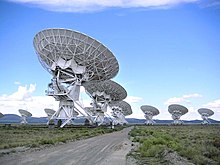
Although some radio waves are produced by astronomical objects in the form of thermal emission, most of the radio emission that is observed from Earth is seen in the form of synchrotron radiation, which is produced when electrons oscillate around magnetic fields. Additionally, a number of spectral lines produced by interstellar gas, notably the hydrogen spectral line at 21 cm, are observable at radio wavelengths.
A wide variety of objects are observable at radio wavelengths, including supernovae, interstellar gas, pulsars, and active galactic nuclei.
Infrared astronomy
Infrared astronomy deals with the detection and analysis of infrared radiation (wavelengths longer than red light). Except at wavelengths
close to visible light, infrared radiation is heavily absorbed by the
atmosphere, and the atmosphere produces significant infrared emission.
Consequently, infrared observatories have to be located in high, dry
places or in space. The infrared spectrum is useful for studying
objects that are too cold to radiate visible light, such as planets and
circumstellar disks.
Longer infrared wavelengths can also penetrate clouds of dust that
block visible light, allowing observation of young stars in molecular clouds and the cores of galaxies. Some molecules radiate strongly in the infrared. This can be used to
study chemistry in space; more specifically it can detect water in
comets.
Infrared astronomy deals with the detection and analysis of infrared radiation (wavelengths longer than red light). Except at wavelengths
close to visible light, infrared radiation is heavily absorbed by the
atmosphere, and the atmosphere produces significant infrared emission.
Consequently, infrared observatories have to be located in high, dry
places or in space. The infrared spectrum is useful for studying
objects that are too cold to radiate visible light, such as planets and
circumstellar disks.
Longer infrared wavelengths can also penetrate clouds of dust that
block visible light, allowing observation of young stars in molecular clouds and the cores of galaxies. Some molecules radiate strongly in the infrared. This can be used to
study chemistry in space; more specifically it can detect water in
comets.
Optical astronomy

The Subaru Telescope (left) and Keck Observatory (center) on Mauna Kea, both examples of an observatory that operates at near-infrared and visible wavelengths. The NASA Infrared Telescope Facility (right) is an example of a telescope that operates only at near-infrared wavelengths.
Ultraviolet astronomy
Ultraviolet astronomy is generally used to refer to observations at ultraviolet wavelengths between approximately 100 and 3200 Å (10 to 320 nm). Light at these wavelengths is absorbed by the Earth's atmosphere, so observations at these wavelengths must be performed from the upper atmosphere or from space. Ultraviolet astronomy is best suited to the study of thermal radiation and spectral emission lines from hot blue stars (OB stars) that are very bright in this wave band. This includes the blue stars in other galaxies, which have been the targets of several ultraviolet surveys. Other objects commonly observed in ultraviolet light include planetary nebulae, supernova remnants, and active galactic nuclei. However, as ultraviolet light is easily absorbed by interstellar dust, an appropriate adjustment of ultraviolet measurements is necessary.X-ray astronomy
X-ray astronomy is the study of astronomical objects at X-ray wavelengths. Typically, objects emit X-ray radiation as synchrotron emission (produced by electrons oscillating around magnetic field lines), thermal emission from thin gases above 107 (10 million) kelvins, and thermal emission from thick gases above 107 Kelvin. Since X-rays are absorbed by the Earth's atmosphere, all X-ray observations must be performed from high-altitude balloons, rockets, or spacecraft. Notable X-ray sources include X-ray binaries, pulsars, supernova remnants, elliptical galaxies, clusters of galaxies, and active galactic nuclei.According to NASA's official website, X-rays were first observed and documented in 1895 by Wilhelm Conrad Röntgen, a German scientist who found them quite by accident when experimenting with vacuum tubes. Through a series of experiments, including the infamous X-ray photograph he took of his wife's hand with a wedding ring on it, Röntgen was able to discover the beginning elements of radiation. The "X", in fact, holds its own significance, as it represents Röntgen's inability to identify exactly what type of radiation it was.
Furthermore, according to the website, in some German speaking countries, X-rays are still sometimes referred to as Röntgen rays, in honor of the man who discovered them.
Gamma-ray astronomy
Gamma ray astronomy is the study of astronomical objects at the shortest wavelengths of the electromagnetic spectrum. Gamma rays may be observed directly by satellites such as the Compton Gamma Ray Observatory or by specialized telescopes called atmospheric Cherenkov telescopes. The Cherenkov telescopes do not actually detect the gamma rays directly but instead detect the flashes of visible light produced when gamma rays are absorbed by the Earth's atmosphere.
Most gamma-ray emitting sources are actually gamma-ray bursts,
objects which only produce gamma radiation for a few milliseconds to
thousands of seconds before fading away. Only 10% of gamma-ray sources
are non-transient sources. These steady gamma-ray emitters include
pulsars, neutron stars, and black hole candidates such as active galactic nuclei.
Fields not based on the electromagnetic spectrum
In addition to electromagnetic radiation, a few other events originating from great distances may be observed from the Earth.
In neutrino astronomy, astronomers use special underground facilities such as SAGE, GALLEX, and Kamioka II/III for detecting neutrinos. These neutrinos originate primarily from the Sun but also from supernovae. Cosmic rays, which consist of very high energy particles that can decay or be absorbed when they enter the Earth's atmosphere, result in a cascade of particles which can be detected by current observatories.
Additionally, some future neutrino detectors may also be sensitive to the particles produced when cosmic rays hit the Earth's atmosphere. Gravitational wave astronomy is an emerging new field of astronomy which aims to use gravitational wave detectors to collect observational data about compact objects. A few observatories have been constructed, such as the Laser Interferometer Gravitational Observatory LIGO, but gravitational waves are extremely difficult to detect.
Planetary astronomers have directly observed many of these phenomena through spacecraft and sample return missions. These observations include fly-by missions with remote sensors, landing vehicles that can perform experiments on the surface materials, impactors that allow remote sensing of buried material, and sample return missions that allow direct laboratory examination.
Astrometry and celestial mechanics
One of the oldest fields in astronomy, and in all of science, is the
measurement of the positions of celestial objects. Historically,
accurate knowledge of the positions of the Sun, Moon, planets and stars
has been essential in celestial navigation and in the making of calendars.Careful measurement of the positions of the planets has led to a solid understanding of gravitational perturbations, and an ability to determine past and future positions of the planets with great accuracy, a field known as celestial mechanics. More recently the tracking of near-Earth objects will allow for predictions of close encounters, and potential collisions, with the Earth.
The measurement of stellar parallax of nearby stars provides a fundamental baseline
in the cosmic distance ladder that is used to measure the scale of the universe.
Parallax measurements of nearby stars provide an absolute baseline for the properties of more distant stars, because their properties can be compared. Measurements of radial velocity and proper motion show the kinematics of these systems through the Milky Way galaxy. Astrometric results are also used to measure the distribution of dark matter in the galaxy.
During the 1990s, the astrometric technique of measuring the stellar wobble was used to detect large extrasolar planets orbiting nearby stars.
Theoretical Astronomy
Theoretical astronomers use a wide variety of tools which include analytical models (for example, polytropes to approximate the behaviors of a star) and computational numerical simulations.
Each has some advantages.
 |
| Related topics |
Analytical models of a process are generally
better for giving insight into the heart of what is going on. Numerical
models can reveal the existence of phenomena and effects that would
otherwise not be seen.
Theorists in astronomy endeavor to create theoretical models and
figure out the observational consequences of those models. This helps
observers look for data that can refute a model or help in choosing
between several alternate or conflicting models.
Theorists also try to generate or modify models to take into account new data. In the case of an inconsistency, the general tendency is to try to make minimal modifications to the model to fit the data. In some cases, a large amount of inconsistent data over time may lead to total abandonment of a model.
Topics studied by theoretical astronomers include: stellar dynamics and evolution; galaxy formation; large-scale structure of matter in the Universe; origin of cosmic rays; general relativity and physical cosmology, including string cosmology and astroparticle physics. Astrophysical relativity serves as a tool to gauge the properties of large scale structures for which gravitation plays a significant role in physical phenomena investigated and as the basis for black hole (astro)physics and the study of gravitational waves.
Some widely accepted and studied theories and models in astronomy, now included in the Lambda-CDM model are the Big Bang, Cosmic inflation, dark matter, and fundamental theories of physics.
A few examples of this process:
Dark matter and dark energy are the current leading topics in astronomy,[47] as their discovery and controversy originated during the study of the galaxies.
| Physical process | Experimental tool | Theoretical model | Explains/predicts |
| Gravitation | Radio telescopes | Self-gravitating system | Emergence of a star system |
Nuclear fusion |
Spectroscopy | Stellar evolution | How the stars shine and how metals formed |
The Big Bang |
Hubble Space Telescope, COBE | Expanding universe | Age of the Universe |
Quantum fluctuations |
Cosmic inflation | Flatness problem | |
Gravitational collapse |
X-ray astronomy | General relativity | Black holes at the center of Andromeda galaxy |
CNO cycle in stars |

No comments:
Post a Comment