
RUMINANTS
A ruminant is a mammal of the order Artiodactyla that digests plant-based food by initially softening it within the animal's first compartment of the stomach, principally through bacterial actions, then regurgitating the semi-digested mass, now known as cud, and chewing it again. The process of rechewing the cud to further break down plant matter and stimulate digestion is called "ruminating".
There are about 150 species of ruminants which include both domestic and wild species. Ruminating mammals include cattle, goats, sheep, giraffes, bison, moose, elk, yaks, water buffalo, deer, camels, alpacas, llamas, antelope, pronghorn, and nilgai. Taxonomically, the suborder Ruminantia includes all those species except the camels, llamas, and alpacas, which are Tylopoda. Therefore, the term 'ruminant' is not synonymous with Ruminantia. The word "ruminant" comes from the Latin ruminare, which means "to chew over again".
The primary difference between a ruminant and non-ruminant (called monogastrics, such as humans, dogs, and pigs) is that ruminants have a four-compartment stomach. The four parts of the stomach are rumen, reticulum, omasum, and abomasum. In the first two chambers, the rumen and the reticulum, the food is mixed with saliva and separates into layers of solid and liquid material. Solids clump together to form the cud or bolus.
The cud is then regurgitated, chewed slowly to completely mix it with saliva and to break down the particle size. Fiber, especially cellulose and hemi-cellulose, is primarily broken down into the three volatile fatty acids, acetic acid, propanoic acid and beta-hydroxybutyric acid, in these chambers by microbes (bacteria, archaea, protozoa, and fungi). Protein and non-structural carbohydrate (pectin, sugars, starches) are also fermented.
Even though the rumen and reticulum have different names they represent the same functional space as digesta can move back and forth between them. Together these chambers are called the reticulorumen. The degraded digesta, which is now in the lower liquid part of the reticulorumen, then passes into the next chamber, the omasum, where water and many of the inorganic mineral elements are absorbed into the blood stream.
After this the digesta is moved to the true stomach, the abomasum. The abomasum is the direct equivalent of the monogastric stomach (for example that of the human or pig), and digesta is digested here in much the same way. Digesta is finally moved into the small intestine, where the digestion and absorption of nutrients occurs. Microbes produced in the reticulorumen are also digested in the small intestine. Fermentation continues in the large intestine in the same way as in the reticulorumen.
Almost all the glucose produced by the breaking down of cellulose and hemi-cellulose is used by microbes in the rumen, and as such ruminants usually absorb little glucose from the small intestine. Rather, ruminants' requirement for glucose (for brain function and lactation if appropriate) is made by the liver from propionate, one of the volatile fatty acids made in the rumen.


Classification
Hofmann and Stewart divided ruminants into three major categories based on their feed type and feeding habits: concentrate selectors; intermediate types; and grass/roughage eaters, with the assumption that feeding habits in ruminants cause morphological differences in their digestive systems, including salivary glands, rumen size, and rumen papillae.
There are also pseudo-ruminants having three-compartment stomach instead of four like ruminants. Monogastric animals such as Guinea pigs, horses and rabbits are not ruminants as they have a simple single-chambered stomach and digest cellulose via an enlarged cecumallowing the easy digestion of fibrous materials. Such animals are called hindgut fermenters.
Wild ruminants number at least 75 million and are native to all continents except Australia and Antarctica. Nearly 90% of all species are found in Eurasia and Africa alone. Species inhabit a wide range of climates (from tropic to arctic) and habitats (from open plains to forests).
The population of domestic ruminants is greater than 3.5 billion, with cattle, sheep, and goats accounting for about 95% of the total population. Goats were domesticated in the Near East at approximately 8,000 B.C. Most other species were domesticated by 2,500 B.C., either in the Near East or southern Asia.
Ruminant Physiology
Ruminating animals have various physiological features which enable them to survive in nature. One feature of ruminants is their continuously growing teeth. During grazing, the silica content in forage causes abrasion of teeth. Abrasion of the teeth is compensated by continuous tooth growth throughout the ruminant's life, as opposed to humans or other non-ruminants whose teeth stop growing after a particular age. Ruminants do not have upper incisors, instead they have a thick dental pad to thoroughly bite food.
The avian and ruminant species have GI tract variations warranting further discussion as they influence the diet consumed and utilization efficiency.
The avian species have variations throughout their GI tract.

Poultry do not have teeth. Poultry use their beak and claws to reduce the particle size of the feed so the feed may be swallowed and digested. The stomach of the avian species is divided into three regions. The first region is the crop. The crop functions as a temporary storage for consumed feed. The second region is the proventriculus. The proventriculus is the glandular stomach of the avian species.
The functions are similar to the previously discussed functions of the glandular stomach. The third region is the gizzard. The gizzard is a dense pouch containing a tough, muscular lining. The interior of the gizzard contains grit or small stones. Via muscular contractions, the gizzard grinds ingested feed. Located subsequent to the small intestine, the avian species have two large ceca. Finally, the avian species have one excretory duct therefore their excrement is a combination of both feces and urine.
This diagram illustrates the general features of a ruminant GI tract.
 |
| The ruminant species possess one significant variation in their GI tract. The ruminant species have one stomach that is divided into four compartments.
Rumen Microbiology
Vertebrates lack the ability to hydrolyse beta [1-4] glycosidic bond of plant cellulose due to the lack of an enzyme celulase. Thus ruminants must completely depend upon the microbial flora, present in rumen or hindgut, so as to digest cellulose. Digestion of food in rumen is primarily carried out by the rumen microflora which contain dense populations of several species of bacteria, protozoa, sometimes yeasts andfungi. It is estimated that 1mm of rumen contains 10-50 billion bacteria, 1 million protozoa and several yeasts, fungi.
As the environment inside a rumen is anaerobic, most of these microbial species are obligate or facultative anaerobes which can decompose complex plant material such as cellulose, hemicellulose, starch, proteins. Hydrolysis of cellulose results in sugars which are further fermentated to acetate, lactate, propionate, butyrate, carbon dioxide and methane.
During grazing, ruminants produce large amount of saliva. Estimates are within 100 to 150 litres of saliva per day for an adult cow. The role of saliva is to provide ample fluid for rumen fermentation and as a buffering agent. Rumen fermentation produces large amounts of organic acids and thus maintaining the appropriate pH of rumen fluids is a critical factor in rumen fermentation.
|

This diagram illustrates the orientation and relative sizes of the four compartments. The first compartment is the reticulum. The feed travels from the esophagus into the reticulum.
Tannin Toxicity In Ruminant Animals
Tannins are phenolic compounds that are commonly found in plants. These compounds play a role in protection from predation, as well as growth regulation, when they are digested by herbivores. Found in the leaf, bud, seed, root, and stem tissues, tannins are widely distributed in many different species of plants. Tannins are separated into two classes: hydrolysable tannins and condensed tannins.
Depending on their concentration and nature either class can have adverse or beneficial effects. When ruminants digest some plants, they acquire a surplus of tannins and rumen microbes do not have the enzymatic ability for degrading condensed tannins. In fact, digestion of tannins by ruminants in large amounts can reduce the activity and the proliferation of ruminal microorganisms reducing ruminal biohydrogenation.
Tannins can also precipitate proteins and inhibit the absorption of nutrients.[14] Very high levels of tannin intake can produce toxicity that can even cause death. Animals normally consuming tannin-rich plants can develop defensive mechanisms against tannins, such as the strategic deployment of lipids and extracellular polysaccharides that have a high affinity to binding to tannins. These mechanisms prevent tannins from causing adverse effects on rumen microbes.
The fact that the ruminant can convert roughages, unsuitable for man, into useful products is normally taken for granted. What enables them to achieve this? The ruminant has three preliminary compartments in its digestive tract before the true stomach, or abomasum. These are the reticulum, rumen, and omasum. The rumen, and reticulum are not completely separated, but have different functions.
Reticulum
The reticulum is a flask-shaped compartment with a "honeycomb" appearance. It moves ingested food (ingesta) into the rumen and the omasum. The reticulum also causes the regurgitation of ingesta during rumination, and acts as a collection compartment for foreign objects.

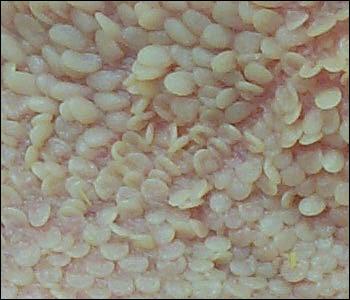
RumenThe rumen is a large fermentation chamber (in adult cattle its volume is about 125 litres) which has a very high population of micro-organisms, mainly bacteria, but also protozoa.It is because the bacteria secrete the enzymes necessary for cellulose degradation that ruminants are able to utilize roughage. The rumen has a textured surface, lined with projections (up to 1 cm long), termed rumen papillae. The rumen, along with the omasum, absorb the by-products of bacterial fermentation. These by-products are volatile fatty acids (VFAs).
Omasum
The omasum, or "manyplies", contains numerous laminae (tissue leaves) that help grind ingesta. These folds assist in the removal of fluid from the ingesta on their way to the abomasum.

Abomasum
This compartment corresponds to the stomach of the non-ruminant, and is termed the true stomach. It secretes the gastric juices which aid in digestion. The pH of the abomasum is normally in the range of 2,0 to 2,5. This low pH facilitates initial protein breakdown, and kills the bacteria which have spilled over from the rumen.Ruminants differ from monogastric animals in the following important ways:

The ruminant represents a classic example of symbiotic association between mammal and micro-organism.
 |
Since different substances are digested by different classes of bacteria, provision must be made to allow a new population of bacteria to establish itself when changes are made in the ration. Changing the composition of a ration, therefore, should be made gradually and it may take up to six weeks for the ruminal organisms to adapt to a change in diet.
A large number of digestive disorders can occur in ruminants. Only three of the more important disorders will be discussed:
BLOAT
Bloat, to which all ruminants are subject, can be of the frothy or the free gas type, and can be either acute or chronic. The term bloat is generally used to describe any condition caused by an excessive accumulation of gas in the rumen.
Important practical considerations in the use of NPN:

Acidosis
|
THE ANATOMY OF A CHICKEN
The diagram below gives a detailed look at the external anatomy of a rooster.

The anatomy of a chicken is rather similar, however Roosters are larger birds.
Chicken and Rooster Combs
There are eight distinctive types of combs on chickens and roosters:rose, strawberry, silkis, single, cushion, buttercup, pea, and V-shaped
 |
The Rose is a solid, broad and nearly flat comb on top. It is a low, fleshly comb that concludes in a well-developed tapering spike at the back. It may turn upward as in Hamburg breeds, be nearly horizontal as in Rose Comb Leghorn breeds, or follow the contour of the head as in Wyandotte breeds. The top surface of the main part should be slightly convex and studded with small rounded protuberances. The general shape varies in the different breeds.
|
 |
The Strawberry is a low comb that is set well-forward. The shape and surface resemble the outer part of half a strawberry with a large end nearest the beak of the chicken.
|
 |
The Silkis is an almost round, somewhat lumpy comb, inclined to be greater in width than length; covered with small corrugations on top and crossed with a narrow transverse indentation slightly to the front of the comb. Sometimes two or three small rear points are hidden by a crest, others are without points. Generally they are considered to be genetically a rose comb changed by a rose comb plus crest.
|
 |
The Single comb is a moderately thin, fleshy formation of smooth soft surface texture, firmly attached from the beak along the top of the skull with a strong base. The top portion shows five or six rather deep serrations or distinct points, the middle points being higher than the back or front, forming a semi-oval shape when viewed from the side. The comb is always upright and much larger and thicker in males than in females. It may be lopped or upright in the female. This depends on the breed. The comb is divided into three sections: the front, the middle and that extending past the rear base of the skull, the posterior or blade.
|
 |
The Cushion is a solid low, moderately small comb; smooth on top, the front, rear and sides are nearly straight with rounded corners. It has no spikes.
|
 |
The Buttercup consists of a single leader from base of beak to a cup-shaped crown set firmly on the centre of the skull and completely surmounted by a circle of regular points. The cavity within the circle of points is deep, the texture of the comb is fine.
|
 |
The Pea is a medium length, low comb, the top of which is marked with three low lengthwise ridges, the centre one is slightly higher that the outer ones. The outer ones are either undulated or marked with small rounded serrations. This is a breed characteristic that is found in Brahmas, Buckeyes, Cornish, Cubalayas and Sumatras.
|
 |
The V-Shaped comb is formed of two well defined horn like sections that are joined at their base, as in breeds such as Houdans, Polish, Crevecoeurs, LeFleche and Sultans.
|
 |
Both the male and female have distinctive wattles, a fleshy piece of hanging skin under their beak and combs. These organs help to cool the bird by redirecting bloodflow to the skin. In males, the combs are often more prominent, though this is not the case in all varieties.
|
The largest chicken egg on record weighed over 12 ounces and measured 14 inches round.
The heaviest chicken is 22lbs. (10kg approx.) and belonged to Grant Sullens of West Point, California, USA. This breed of chicken is a' White Sully'. It is known to have a very mean temper as it has been reported to have killed two cats and wounded a dog.
Chickens are quite speedy little birds, they can run about 9 miles per hour.

Particularly when being chased!
The longest distance flown by any chicken is 301.5 feet.

With a population of more than 24 billion in 2003, there are more chickens in the world than any other bird. Chickens provide two sources of food frequently consumed by humans: their meat, also known as chicken, and eggs which they lay.
Chickens have a great usefulness to humans. Chickens can be kept as pets, for breeding, egg laying and a food product. There are many different breeds that come in a variety of colours.
Roosters can usually be differentiated from hens by their striking plumage, marked by long flowing tails and bright pointed feathers on their necks. The rooster is larger and more brightly coloured than the hen, he also has a larger comb on top of his head.
Roosters make a very loud crowing sound usually very early in the morning but they can crow anytime of the day. Their loud shrill is a territorial sign to other roosters. They can also be quite aggressive birds. Hens lay eggs that range in colour from white to pale brown and other pale colours depending on the breed.
Chicken Diet
Chickens have a varied diet. Chickens are omnivores and will feed on small seeds, herbs and leaves, grubs, insects and even small mammals like mice, if they can catch them. Domestic chickens are typically fed commercially prepared feed that includes a protein source as well as grains. Chickens often scratch at the soil to get at adult insects and larva or seed. Chickens have a well-developed gizzard (a part of the stomach that contains tiny stones) that grinds up their food.
Flightless Birds
Although chickens are flightless birds, they do have a tendency to attempt flight. Chickens do this by runing and flapping their wings. Unfortunately, they are not capable of staying air bourne. Chickens sometimes can fly for very short distances such as over fences. Chickens will sometimes attempt flight simply to explore their surroundings, however, they will especially fly in an attempt to flee when they perceive danger or pursued by a predator.
Chicken Behaviour
Chickens are gregarious birds and live together as a flock. Chickens have a communal approach to the incubation of eggs and raising of young. Individual chickens in a flock will dominate others, establishing a 'pecking order', with dominant individuals having priority for access to food and nesting locations. Removing hens or roosters from a flock causes a temporary disruption to this social order until a new pecking order is established.
Chicken Reproduction
When a rooster finds food he may call the other chickens to eat it first. He does this by clucking in a high pitch as well as picking up and dropping the food. This is part of chicken courting ritual. When a hen becomes familiar coming to his 'call' the rooster may mate with the hen and fertilize her egg.
Broody Hens
Sometimes a hen will stop laying eggs to concentrate on the incubation of her eggs. This state is commonly known as 'going broody'. A broody hen will sit fast on her nest and will protest if disturbed or removed. She will rarely leave the nest to eat, drink or dust-bathe. All the time she is sitting in the nest she will regularly turn the eggs keeping them at a constant temperature and humidity.
At the end of the incubation period, which is an average of 21 days, the eggs (if fertilized) will hatch and the broody hen will take care of her young. Since individual eggs do not all hatch at exactly the same time (the chicken can only lay one egg approximately every 25 hours), the hen will usually stay on the nest for about two days after the first egg hatches. During this time, the newly-hatched chicks live off the egg yolk they absorb just before hatching. The hen can hear the chicks peeping inside the eggs, and will gently cluck to encourage them to break out of their shells. If the eggs are not fertilized and do not hatch, the hen will eventually grow tired of being broody and leave the nest.
Modern egg-laying breeds rarely go broody and those that do often stop part-way through the incubation cycle. Some breeds, such as the Cochin, Cornish and Silkie, regularly go broody and make excellent mothers.
Chicken Life Span
The life span of a chicken varies between 5 - 7 years although there have been cases of chickens living 20 years or so.
Chicken Predators
Besides humans, lots of animals eat chickens as well. The chickens predators include: skunks, owls, raccoons, hawks, snakes, opossums, bobcats and foxes.
 | ||||||||||
Anatomy of an egg
The color of the shell varies according to the breed: white, cream-coloured, brown, blue-green, etc. It is a genetic factor which is without effect on the food value or savour of eggs. The shell primarily consists of limestone (calcium carbonate). The shell protects eggs from the shocks and evaporation; it is semipermeable (it lets pass oxygen and carbon dioxide; it prevents the microbial penetration) and includes approximately 10 000 pores.

Under the shell are the shell membranes (outer and inner), being used a protection against the undesirable elements (moulds, bacteria).
At one end of the egg, there is the air cell. Non-existent to the moment of the laying, the cooling of the egg, brings the formation of an air cell between the 2 shell membranes.
The albumen surrounds the vitellus. It is used as a shock protection. The albumen located in periphery is more fluid. The remainder is more viscous. During the development of the embryo, it will provide water and proteins.
The chalazae are used to maintain the vitellus in the center of the egg.
The vitellus is surrounded by a thin membrane. The germ is located there and is being used as starting point for the development of future chick. For a good embryonic development, it is important that the germ remains on the top of the vitellus. This is made possible by the chalazae. The remainder of the vitellus will be used as nutritive matter for the embryo.
|


 |
Eggs are a biological structure intended by nature for reproduction of birds. They protect the developing chick embryo and provide food for the first few days of the chick’s life. The egg is also one of
the most nutritious and versatile of human foods.
Eggs of domestic chickens may be white, many shades of brown, or yellow. One breed lays bluegreen eggs. Sometimes very small, dark flecks are present on the eggshell, especially if it is brown.
Egg color often assumes economic importance, as there are numerous local prejudices in favor of
shell tints. Colored eggs occur because pigment is deposited in the shell as it is formed in the uterus.
The protective covering known as the shell is composed primarily of calcium carbonate, with 6,000
to 8,000 microscopic pores permitting transfer of volatile compounds. The air cell is located in the
large end of the egg, and is formed when the cooling egg contracts and pulls the inner and outer shell
membranes apart. The chordlike chalazae holds the yolk in position in the center of the egg. As
shown, a membrane surrounds the yolk, known as the vitelline membrane. The germinal disc, a
normal part of every egg, is located on the surface of the yolk. Embryo formation begins here only
in fertilized eggs.
 | |||||||||||||||||||||||||||||||||||||||||||||||||||||||||||||||||||||||||||||||||
Functions Of Egg Parts |
| 1. | air cell | an empty space located at the large end of the egg; it is between the inner and outer shell membranes | |
| 2. | Albumin | white part of egg, supplies protien to the developing embryo | |
| 3. | Chalazae | fibrous structures at the ends of the yolk, aiding in centering the yolk within the white | |
| 4. | class | aves | |
| 5. | Domain for chicken | Eukarya | |
| 6. | Eggshell | protective outer layer of the egg, composed of calcium carbonate | |
| 7. | family | phasianidae | |
| 8. | genus | gallus | |
| 9. | germinal disc | small, circular, white spot on the surface of the yolk; it is where the sperm enters the egg. | |
| 10. | Incubation period | 21 days | |
| 11. | inner shell membrane | thin membrane located between the outer shell membrane and the albumin | |
| 12. | kingdom | animalia | |
| 13. | order | galliformes | |
| 14. | outer shell membrane | thin membrane located just inside the shell. | |
| 15. | phylum | chordata | |
| 16. | species | G. domesticus | |
| 17. | subphylum | vertebrata | |
| 18. | temperature range for incubator | 99 degrees F to 102 degrees F | |
| 19. | Vitelline membrane | The membrane surrounding the egg yolk | |
| 20. | Yolk | supplies nutrients to developing embryo. |

No comments:
Post a Comment